Contents
- 1 Detox vs Residential Rehab: How to Choose the Right Level of Addiction Treatment in California
- 1.1 Detox vs Residential Rehab: the Core Difference
- 1.2 When Detox Is the Safest First Step
- 1.3 When Someone May Enter Residential Rehab Without Detox
- 1.4 How Level of Care Decisions Are Made in California
- 1.5 What Happens After Detox Before Residential Treatment
- 1.6 Common Mistakes People Make When Choosing Care
- 1.6.1 Mistake 1: assuming detox and rehab are the same thing
- 1.6.2 Mistake 2: treating detox as the full solution
- 1.6.3 Mistake 3: trying to self-determine withdrawal risk
- 1.6.4 Mistake 4: focusing only on the first few days
- 1.6.5 Mistake 5: choosing a setting that does not fit privacy needs
- 1.6.6 Mistake 6: failing to ask what happens after admission
- 1.6.7 Mistake 7: assuming all substances follow the same timeline
- 1.7 How to Decide What to Do Next
- 1.8 Frequently Asked Questions
- 1.8.1 How do I know if I need medical detox before residential rehab?
- 1.8.2 Can someone go straight into residential treatment without detox?
- 1.8.3 How long does detox usually last before residential rehab begins?
- 1.8.4 Is detox and residential rehab more expensive than starting with one program alone?
- 1.8.5 What should families in California ask during an admissions call?
- 1.9 Choosing Between Detox and Residential Rehab in California
Detox vs Residential Rehab: How to Choose the Right Level of Addiction Treatment in California
When people compare detox vs residential rehab, they are often trying to answer a very practical question: What should happen first, and what level of care is safest right now? The confusion is understandable. Detox and residential treatment are closely connected, but they do not do the same job.
At Altus Rehab, adults and families across Los Angeles, Encino, Beverly Hills, Burbank, Woodland Hills, Glendale, Malibu, Santa Clarita, Santa Monica, Tarzana, Hollywood Hills, Agoura Hills, Van Nuys, and the Greater L.A. area often ask whether a person should begin with medical detox or move directly into a residential treatment program. The answer depends on the substance being used, how long and how heavily it has been used, current withdrawal risk, medical and mental health concerns, and how much structure the person needs once withdrawal begins to settle.
This guide explains the core difference between detox stabilization and residential treatment, when detox is usually the safer first step, when someone may enter residential rehab without detox, how level of care decisions are made in California, and what families should ask before choosing a program. If you want more background on withdrawal management itself, see How Does Medical Detox Work? What to Expect, Step by Step and Luxury Detox in California: What to Expect from a Detox Program.
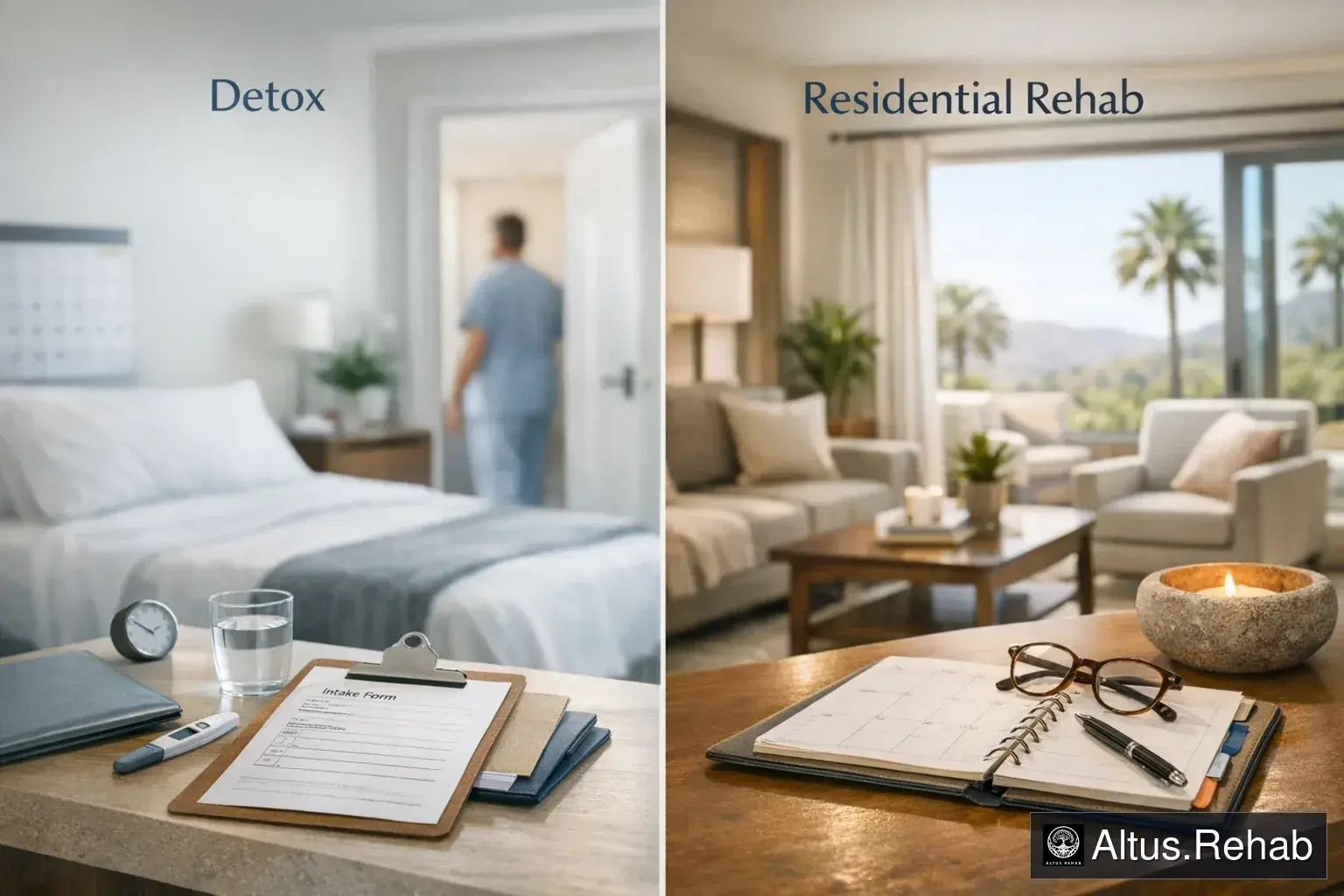
Detox vs Residential Rehab: the Core Difference
The simplest way to understand medical detox vs residential rehab is this:
- Detox focuses on stabilization during withdrawal.
- Residential rehab focuses on ongoing treatment, structure, and recovery work after the immediate withdrawal period is addressed.
What detox is designed to do
Detox is not primarily a therapy program. Its first job is safety. In a medically supervised detox setting, the treatment team monitors symptoms, responds to changes in condition, supports hydration, nutrition, rest, and comfort, and helps manage withdrawal in a way that reduces medical risk. This matters because withdrawal can range from deeply uncomfortable to medically dangerous depending on the substance, the pattern of use, and the person’s health history.
For example, people withdrawing from alcohol or benzodiazepines may face risks that require close clinical observation. People coming off opioids, fentanyl, heroin, kratom, or other substances may not all have the same danger profile, but they can still experience intense distress, cravings, sleep disruption, agitation, and physical symptoms that make it hard to stay engaged in care without support.
In other words, detox is about getting through the acute withdrawal period safely enough and comfortably enough to participate in the next phase of treatment.
What residential rehab is designed to do
Residential addiction treatment in California is a live-in level of care that provides daily structure, therapeutic programming, accountability, and a protected environment away from the people, places, and routines that often fuel substance use. In residential rehab, the person is no longer just trying to get through the first withdrawal window. The focus shifts toward understanding the addiction pattern, building coping skills, working through triggers, establishing routines, and preparing for longer-term recovery.
Residential care often helps with:
- Craving management after acute detox
- Mental and emotional stabilization
- Relapse pattern review
- Daily therapeutic structure
- Early recovery routines
- Family communication and planning
- Transition planning for the next level of care
If detox is the phase that helps someone become physically stable enough for treatment, residential rehab is the phase that helps them begin doing the real recovery work in a highly structured setting. For a closer look at this setting, visit Luxury Residential Addiction Treatment in Los Angeles, CA.
Why people confuse the two
Many people assume detox and rehab are interchangeable because they sometimes happen in one continuous stay. But they answer different clinical needs. A person may complete detox and still be emotionally overwhelmed, impulsive, sleep deprived, depressed, or highly vulnerable to returning to use. That is one reason detox alone is often not enough. Stabilization is important, but it is not the same thing as treatment for the underlying addiction pattern.
That distinction matters for alcohol use disorder, benzodiazepine dependence, opioid use, fentanyl exposure, methamphetamine addiction, cocaine use, cannabis dependence, kratom use disorder, and other substance-related concerns. Some people need both levels of care in sequence. Some need residential treatment without a separate detox stay. The right answer depends on assessment, not assumptions.
When Detox Is the Safest First Step
One of the most common questions families ask is when do you need detox first. While every case should be assessed individually, there are clear situations where detox should be strongly considered before residential rehab begins.
Alcohol withdrawal risk
Alcohol is one of the clearest examples of a substance that may require medical detox first. If someone has been drinking heavily, daily, or for a long period of time, stopping suddenly can create serious withdrawal concerns. This is especially true if the person has:

- A history of significant alcohol withdrawal symptoms
- Past seizures during withdrawal
- Severe tremors, sweating, agitation, or confusion when trying to stop
- Co-occurring medical issues
- A pattern of drinking from morning to night or drinking to avoid feeling sick
Someone in that situation usually needs more than encouragement and a quiet room. They need monitoring and a plan. Readers comparing treatment options may also find it useful to review Altus Rehab’s article on alcohol-related symptom patterns, including early discomfort and instability after stopping alcohol.
Benzodiazepine withdrawal risk
Benzodiazepines such as Xanax, Ativan, Klonopin, or Valium can create complex and potentially dangerous withdrawal concerns, particularly after regular or long-term use. This is one of the clearest cases where self-detox can be risky. A person may look functional on the outside and still have a withdrawal profile that requires careful tapering, symptom monitoring, and medical oversight.
Red flags that often point toward detox first include:
- Daily benzodiazepine use
- High-dose use or escalating use
- Combining benzodiazepines with alcohol or opioids
- Previous failed attempts to stop
- Rebound anxiety, panic, insomnia, tremors, or perceptual changes when reducing use
Altus Rehab also provides substance-specific support for this need, including care related to Xanax detox in Los Angeles.
Opioids, heroin, and fentanyl withdrawal
Withdrawal from heroin, fentanyl, prescription opioids, and similar substances is often extremely uncomfortable and can quickly derail treatment attempts, even when it is not medically dangerous in the same way alcohol or benzodiazepine withdrawal may be. Many people intending to “go straight to rehab” leave before treatment really begins because the physical symptoms hit hard enough to overpower motivation.
A medically supervised detox can help people move through:
- Body aches and severe discomfort
- Nausea, vomiting, diarrhea, and dehydration concerns
- Insomnia and restlessness
- Anxiety and agitation
- Intense cravings early in withdrawal
When these symptoms are addressed early, the person is often better able to remain in care and transition into residential treatment rather than leaving during the first difficult days.
Kratom dependence and withdrawal
Kratom is sometimes underestimated because it is plant-derived, but dependence can still become significant. People using high amounts or using frequently through the day may experience withdrawal symptoms that interfere with functioning and make treatment engagement difficult. In some cases, individuals with kratom use disorder also have a history of opioid use or are using other substances at the same time, which can make detox planning more complex.
Altus Rehab offers substance-specific care for kratom-related concerns, and families comparing levels of care should not assume kratom withdrawal is always mild or easy to handle without supervision.
Methamphetamine, cocaine, and other stimulants
Stimulant withdrawal does not always require detox in the same way alcohol or benzodiazepines do, but some individuals still benefit from a detox setting first. Methamphetamine and cocaine use can be followed by a crash period involving exhaustion, agitation, depression, sleep disruption, poor nutrition, paranoia, or intense cravings. Even if a person does not need a classic withdrawal-management protocol, they may need stabilization before they can participate meaningfully in residential treatment.
This is especially true if the person has been awake for long periods, is highly disorganized, has not been eating, or is showing serious emotional instability after stopping use.
Polysubstance use
If someone is using more than one substance, the need for detox rises quickly. Alcohol plus benzodiazepines, opioids plus benzodiazepines, stimulants plus alcohol, or mixed drug use with uncertain street supply can make withdrawal less predictable. A private, medically supervised setting is often the safest way to begin care when families are not fully sure what has been taken, how much has been used, or what symptoms may emerge in the first several days.
Past withdrawal problems or failed attempts to quit
Even if the current symptoms do not look dramatic yet, a person may still need detox first if they have repeatedly tried to stop and could not get through the early phase. A history of leaving treatment, returning to use immediately after trying to quit, or becoming severely symptomatic within a day or two of stopping are all signs that the first stage of care needs more support.

If you are unsure how long this first phase may last, see How Long Does Medical Detox Take? Timelines, Symptoms & Safe Next Steps.
When Someone May Enter Residential Rehab Without Detox
Not every person needs a separate detox stay. One of the most important points in any detox vs residential rehab comparison is that treatment should be matched to the person’s current condition, not automatically escalated or minimized.
If there is no significant withdrawal risk
Some people are not physically dependent in a way that creates major withdrawal concerns. They may still have a serious substance use disorder and still need residential treatment, but they may not need a medically managed detox first. For example, a person might be using in a binge pattern rather than a daily dependence pattern, or they may have already gone through the acute withdrawal window before admission.
That does not mean their situation is mild. It simply means their primary need may be structure, relapse prevention, therapy, and removal from a high-risk environment rather than a separate withdrawal-management phase.
If withdrawal has already passed
Sometimes a person has already stopped using for several days before reaching out. If they are no longer in acute withdrawal and a clinical assessment does not identify ongoing instability requiring detox-level supervision, they may enter residential treatment directly.
However, families should be cautious about making that call on their own. A person may say, “I already detoxed at home,” but still be experiencing ongoing symptoms, sleep disruption, anxiety, blood pressure concerns, cravings, or mental health instability that affect the safest entry point.
If the main need is environment and structure
There are also people whose greatest immediate risk is not dangerous withdrawal but rapid return to use if they stay in their current environment. Someone may need residential addiction treatment because they cannot maintain abstinence at home, are surrounded by enabling relationships, are cycling through binges, or are too vulnerable to triggers to remain safe and engaged on their own.
In these cases, residential care may be appropriate even without a separate detox track, especially if the treatment team can continue monitoring any mild residual symptoms during the transition.
If a clinical assessment shows residential is the right starting point
The key issue is not whether detox sounds more comprehensive. The key issue is whether detox is clinically necessary. If the admissions and clinical team determine that withdrawal risk is low and the person is medically and psychiatrically appropriate for residential treatment, starting there may make sense. That can reduce unnecessary delays and get the person into active treatment faster.
What this means for cost questions
Families often ask whether detox and residential rehab together are more expensive than entering one program alone. The practical answer is that the right level of care is based on clinical need, not on trying to skip a necessary step. If someone clearly needs detox first, avoiding it can create larger problems: incomplete withdrawal, leaving treatment early, emergency complications, or rapid return to use before the person ever reaches the therapeutic part of care.
On the other hand, if someone does not need detox, a good assessment should not force them into a higher level of care than necessary. The right admissions conversation should help clarify the medically appropriate starting point, how a detox timeline before rehab may apply, and whether both levels of care are likely to be part of the same recovery plan.
How Level of Care Decisions Are Made in California
In California, deciding between detox and residential treatment is not supposed to be guesswork. A proper admissions process looks at immediate safety needs first, then the level of structure and treatment intensity needed after stabilization.
Clinical assessment comes before placement
Before someone is admitted, the clinical team typically gathers information about:
- Primary substances used
- Amount, frequency, and duration of use
- Date and time of last use
- Past withdrawal history
- Past overdose history or severe complications
- Current physical symptoms
- Mental health symptoms and current emotional state
- Medical conditions and medications
- Sleep, appetite, and functioning
- Home environment and relapse risk
- Prior treatment experiences
This information helps determine whether the person needs withdrawal management first, whether they can safely begin residential addiction treatment in California, or whether some other level of care would fit better.

Why substance type matters, but is not the whole story
Substance type matters because different drugs produce different withdrawal patterns. Alcohol and benzodiazepines raise specific safety concerns. Opioids and fentanyl often produce severe distress that can undermine treatment engagement. Stimulants may require stabilization for crash symptoms, depression, exhaustion, or psychiatric concerns. Kratom can complicate things further depending on dose, duration, and co-use with other substances.
But no responsible assessment relies on substance alone. Two people using the same drug may need different starting levels of care based on age, health history, tolerance, prior withdrawal complications, and current presentation.
Why privacy and setting also matter
For many professionals, executives, public-facing individuals, and families in areas like Beverly Hills, Santa Monica, Malibu, Encino, and Hollywood Hills, privacy concerns are part of the decision-making process. A high-end, confidential setting can make it easier for someone to accept care instead of delaying treatment because they fear exposure, disruption, or loss of dignity.
Privacy should not determine the clinical level of care, but it absolutely affects whether someone is willing to enter treatment. In practice, a luxury detox California program or a private residential setting can help remove barriers that keep people stuck.
Why California families should look for continuity
One of the most practical considerations in California is continuity between levels of care. If detox and residential treatment are coordinated, the person does not have to start over with a new team every few days. That can reduce confusion, decrease resistance, and lower the chance of dropping out during a vulnerable handoff.
Continuity matters because motivation often fluctuates. A person may agree to detox because they feel physically miserable, then decide they are “fine now” as soon as withdrawal begins to ease. If there is a smooth pathway into residential care, the transition is easier and the therapeutic work can begin before that window closes.
What “appropriate level of care” really means
The right level of care is the least restrictive setting that is still safe and effective for the person’s current condition. That means:
- Not minimizing withdrawal risk when detox is needed
- Not overstating detox needs when residential is enough
- Looking beyond the first 72 hours to what supports actual treatment engagement
- Building a plan that addresses both stabilization and ongoing recovery needs
Organizations such as SAMHSA, ASAM, NIDA, and the California Department of Health Care Services all contribute to the broader standards and language around levels of care, withdrawal management, and treatment matching. For families, the practical takeaway is simple: ask how the recommendation is being made and what clinical factors support that recommendation.
What Happens After Detox Before Residential Treatment
Many people picture a sharp line between detox and rehab, but the handoff is usually more gradual. After detox, the person may no longer be in the most intense withdrawal phase, yet they may still feel physically depleted, emotionally reactive, or mentally foggy. That is exactly why the transition period matters.
Step 1: reassessment after stabilization
Once acute withdrawal symptoms begin to settle, the team reassesses the person’s condition. This includes looking at:
- Residual physical symptoms
- Sleep quality
- Appetite and hydration
- Mood and anxiety level
- Mental clarity and focus
- Craving intensity
- Motivation for continued treatment
This is the point where it becomes clear whether the person is ready to move directly into residential programming or whether additional stabilization is still needed.
Step 2: orientation into treatment structure
Residential treatment begins introducing the daily structure that supports recovery: schedule, expectations, therapy participation, therapeutic groups, rest, meals, and clinical routines. Someone who has just finished detox may need a short adjustment period, especially if they are sleep-deprived or emotionally raw.
That adjustment is normal. Detox removes the immediate barrier of withdrawal. Residential treatment begins building the stability that detox alone cannot provide.

Step 3: beginning the deeper work
As the person becomes more physically stable, treatment starts focusing on the drivers of substance use. Depending on the individual, this may include:
- Identifying patterns that led to use
- Reviewing relapse history
- Addressing shame, secrecy, or ambivalence
- Managing cravings and triggers
- Exploring co-occurring emotional difficulties
- Rebuilding routines and accountability
- Preparing family communication and discharge planning
For many people, this is the first time they are able to think clearly enough to engage in treatment. That is another reason detox and residential rehab should not be treated as substitutes. One prepares the ground; the other begins the rebuilding.
Why continuity can reduce dropout risk
A major danger point in addiction treatment is the gap between “I finished detox” and “I’m committed to ongoing treatment.” If there is too much delay, too much travel, or too many handoffs, the person may decide to go home, test themselves, or postpone the next step. That often leads right back to use.
Continuity between detox and residential care can reduce dropout risk by:
- Keeping momentum during a vulnerable transition
- Maintaining therapeutic rapport
- Reducing logistical stress
- Limiting opportunities to leave treatment impulsively
- Helping families understand the plan from the start
If you want to compare what the detox stage itself may involve before this transition, review How Does Medical Detox Work? What to Expect, Step by Step and How Long Does Medical Detox Take? Timelines, Symptoms & Safe Next Steps.
Common Mistakes People Make When Choosing Care
When families are stressed, sleep-deprived, and trying to move fast, it is easy to make treatment decisions based on fear, urgency, or incomplete information. Here are some of the most common mistakes that come up when comparing levels of addiction treatment.
Mistake 1: assuming detox and rehab are the same thing
This is the biggest source of confusion. Detox addresses withdrawal and stabilization. Residential rehab addresses the behavioral, emotional, and environmental sides of addiction. If someone needs both, replacing one with the other usually leaves a major gap.
Mistake 2: treating detox as the full solution
Families are often so relieved to get a loved one safely through withdrawal that they underestimate what comes next. But once the body starts to stabilize, cravings, denial, emotional swings, and relapse triggers do not simply disappear. Without a follow-up plan, people can return to use quickly after detox.
Mistake 3: trying to self-determine withdrawal risk
It is common to hear, “They can probably just rest for a few days and then go to rehab.” The problem is that withdrawal risk is not always obvious to a family member, and some substances create delayed or evolving complications. Alcohol and benzodiazepines are especially important examples. A clinical assessment is safer than a guess.
Mistake 4: focusing only on the first few days
Some people choose care based only on how to survive the weekend or get through the next 72 hours. That is understandable, but it can miss the larger issue: what setting gives this person the best chance of staying engaged in treatment after the immediate crisis calms down?
Someone may be stable enough to leave detox but still not be ready to go home. Residential treatment can be the bridge between early stabilization and a more durable recovery plan.
Mistake 5: choosing a setting that does not fit privacy needs
For adults in Los Angeles and surrounding communities, privacy can be a deciding factor. If the setting feels too exposed, chaotic, or misaligned with the person’s need for discretion, they may resist treatment or leave early. Clinical appropriateness comes first, but the treatment environment still matters. A private, high-touch, medically supervised setting can make acceptance of care more realistic.
Mistake 6: failing to ask what happens after admission
Families sometimes ask only, “Can you take them?” A better question is, “If they start with detox, what happens next? If they start with residential, how will withdrawal or residual symptoms be monitored?” The quality of the transition plan matters just as much as the admission itself.

Mistake 7: assuming all substances follow the same timeline
The detox timeline before rehab differs by substance and by person. Alcohol, benzodiazepines, opioids, methamphetamine, kratom, cocaine, cannabis, and polysubstance use all have different symptom patterns and treatment implications. A realistic program should explain that clearly rather than offering a generic answer to every case.
How to Decide What to Do Next
If you are trying to choose between medical detox and residential rehab, the next step is not to force a label. The next step is to clarify the person’s immediate risks, current symptoms, and likely treatment path.
Ask these practical questions first
- What substances are involved?
- How often is the person using, and in what amounts?
- When was the last use?
- Have they ever had serious withdrawal symptoms before?
- Have they tried to stop and been unable to get through the first days?
- Are they medically stable right now?
- Are they sleeping, eating, and thinking clearly enough to engage in treatment?
- Would they be likely to leave or use again if sent home between levels of care?
- Do they need a confidential setting because privacy concerns are delaying treatment?
The answers can help frame the admissions discussion and make it easier to identify whether detox, residential care, or a coordinated sequence of both makes the most sense.
What families in California should ask during an admissions call
A good admissions call should not feel like a scripted sales conversation. It should help you understand the recommendation and the reasoning behind it. Families in California should consider asking:
- Based on the substances and symptoms described, do you recommend detox first or direct residential admission?
- What specific withdrawal risks are you considering?
- If detox is recommended, what signs point to that level of care?
- How is the person monitored during early withdrawal or early stabilization?
- How soon can residential treatment begin after detox?
- What does continuity between detox and residential look like?
- How do you handle privacy and confidentiality for professionals or high-profile individuals?
- What should the family expect during the first 24 to 72 hours?
- What happens if symptoms change after admission?
- How will the team help determine which level of care fits their situation best?
A practical decision rule
If there is meaningful uncertainty about withdrawal risk, severe symptoms, or the ability to remain safe and engaged during early abstinence, detox should be evaluated first. If there is low withdrawal risk but a clear need for structure, separation from triggers, and daily treatment, residential care may be the right starting point. If both are needed, the best plan is usually a smooth transition rather than a gap between services.
Frequently Asked Questions
How do I know if I need medical detox before residential rehab?
You may need medical detox first if stopping or reducing substance use is likely to cause significant withdrawal symptoms, medical complications, or severe distress that would prevent you from participating in treatment. This is often a concern with alcohol, benzodiazepines, opioids, fentanyl, heroin, and some cases of kratom or polysubstance use. Past withdrawal complications, seizures, failed attempts to quit, severe physical symptoms, or uncertainty about what substances are involved are all reasons to ask for a detox assessment first.
Can someone go straight into residential treatment without detox?
Yes, some people can enter residential treatment without a separate detox stay if they are not in acute withdrawal, do not have significant medical risk from stopping, and the primary need is structure, therapy, accountability, and a protected environment. This decision should still be based on a clinical assessment rather than self-screening at home.
How long does detox usually last before residential rehab begins?
There is no single timeline for everyone. The length of detox depends on the substance, pattern of use, withdrawal history, co-occurring conditions, and how the person responds during early stabilization. Some people transition quickly into residential treatment, while others need a longer withdrawal-management period before they are ready to participate fully. A realistic admissions conversation should explain likely ranges without pretending every case follows the same schedule.
Is detox and residential rehab more expensive than starting with one program alone?
If a person truly needs both levels of care, combining them is often the clinically appropriate path rather than an avoidable extra. Trying to skip a needed detox phase can lead to treatment interruption, unsafe withdrawal, early discharge, or rapid return to use. At the same time, a proper assessment should not recommend a higher level of care than necessary. The goal is not “more treatment” for its own sake; it is the right treatment sequence for the person’s safety and recovery needs.
What should families in California ask during an admissions call?
Families should ask what level of care is recommended, why that recommendation fits the person’s symptoms and substance use history, what the immediate withdrawal or safety concerns are, how monitoring works, how quickly residential care can follow detox if needed, and how confidentiality is protected. It is also helpful to ask what the first few days will look like and what signs would change the treatment recommendation after admission.
Choosing Between Detox and Residential Rehab in California
The most important takeaway in any detox vs residential rehab comparison is that these levels of care are complementary, not interchangeable. Detox addresses the immediate problem of withdrawal and physical stabilization. Residential treatment addresses the next problem: how to build enough structure, support, and therapeutic momentum to stay engaged in recovery once the body begins to settle.
For some adults in Los Angeles and throughout California, detox is clearly the safest first step. For others, residential treatment may be the right place to begin. And for many, the strongest plan is a coordinated path from medically supervised detox into residential care without a disruptive gap in between.
If you are weighing options for yourself or someone close to you, Altus Rehab can help you talk through which level of care fits the current symptoms, substance use history, safety needs, timeline, and privacy preferences. For a confidential, 24/7 admissions conversation focused on whether detox, residential treatment, or a combined plan makes the most sense, call (844) 656 3164.